How to Manage Multiple Brand Deals Without Losing Track
Juggling 5, 10, 15 brand deals at once? Learn the systems Indian creators use to track campaigns, deadlines, invoices, and payments without dropping the ball.
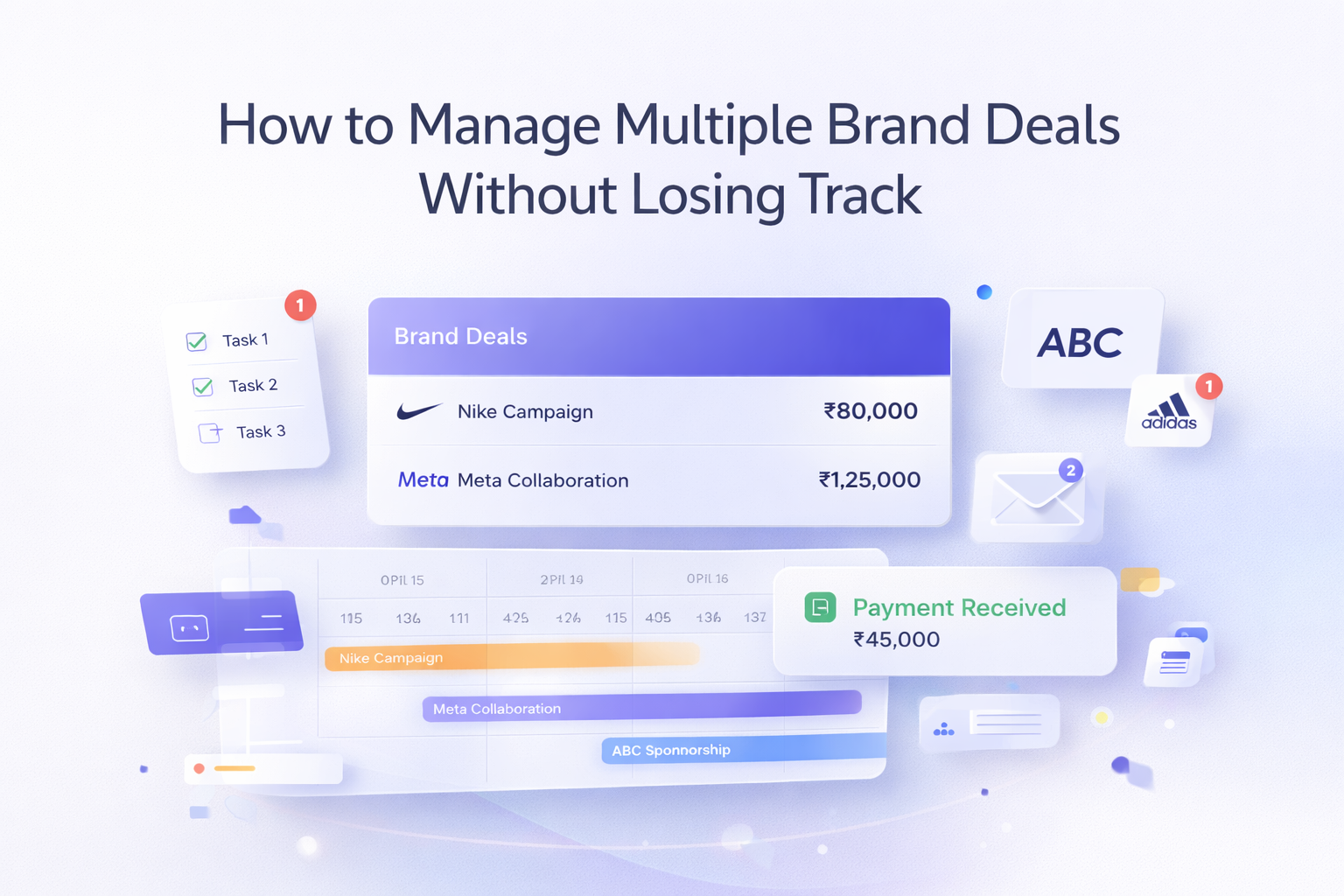
When Brand Deals Become a Full-Time Job
You started creating content because you loved it. Then brand deals started coming in — first one, then three, then ten running simultaneously.
Suddenly you're tracking deliverables in your head, missing invoice follow-ups, forgetting which brand paid and which didn't, and spending your editing time chasing payments instead.
Managing multiple brand deals without a system is not a creativity problem — it is an operations problem. And it has a solution.
This guide lays out the exact system that full-time Indian creators use to manage 10-20 active brand deals without chaos.
Why Brand Deal Management Breaks Down
The Three Failure Points
Most creators lose track of brand deals at one of three points:
• Deliverable tracking — forgetting what was agreed, when it's due, and what format the brand expects
• Invoice follow-up — not knowing which invoices are outstanding, how long they've been pending, and when to escalate
• Payment reconciliation — not knowing if the amount received matches the invoice, especially after TDS deductions
Each of these is solvable with a simple system. You don't need expensive project management software — but you do need something more structured than WhatsApp messages and a mental note.
The Brand Deal Lifecycle — What You Actually Need to Track
Every brand deal passes through the same stages. Understanding this lifecycle is the foundation of any management system.
|
Stage |
Key Actions |
Documents Needed |
|
Negotiation |
Agree on deliverables, timeline, and fee |
Rate card, scope document |
|
Contracting |
Sign agreement or exchange emails confirming scope |
Contract / email chain |
|
Content Creation |
Create, review, revise content per brief |
Brand brief, revision notes |
|
Delivery |
Submit content for brand approval |
Delivery confirmation |
|
Invoice Raised |
Send GST-compliant invoice |
Invoice PDF with GSTIN, SAC code |
|
Payment Follow-up |
Track due date, send reminders |
Invoice tracking log |
|
Payment Received |
Verify amount after TDS, acknowledge receipt |
Bank statement, Form 16A |
|
Post-Campaign |
Archive deliverables, note brand feedback |
Performance data if shared |
The Minimum Viable Tracking System
Option 1 — Spreadsheet (Free, Functional)
For creators managing under 5 active deals, a well-structured Google Sheet can work. Your sheet should have these columns:
• Brand Name
• Campaign Name / Product
• Deliverables (e.g., '1 Reel + 3 Stories + 1 YouTube Integration')
• Content Due Date
• Invoice Amount (excl. GST)
• Invoice Number
• Invoice Date
• Payment Due Date (usually 30-45 days from invoice)
• Payment Status (Unpaid / Partial / Paid)
• Amount Received
• TDS Deducted
• Notes
This covers the basics. The limitation: it requires manual updating, sends no reminders, and has no payment integration.
Option 2 — Notion or Trello (Free, Visual)
Notion databases or Trello boards let you visualise deals by stage (a Kanban view). You can create cards for each brand deal and move them through stages: Negotiating → In Progress → Invoiced → Paid.
This works well for deliverable tracking and gives a quick overview of what is happening across all deals. However, it has the same limitation as a spreadsheet for financial tracking — no GST invoice generation, no payment links, no automated reminders.
Option 3 — Dedicated Creator Platform (Recommended for 5+ Deals)
Once you are managing 5 or more active deals simultaneously, a dedicated platform pays for itself in time saved and payments collected faster.
AdivoQ's Brand and Campaign CRM was built for exactly this workflow. Each brand has a profile with their GSTIN, billing details, and contact information that auto-fills on every invoice. Each campaign is tracked with deliverables, milestones, and linked invoices. Payment status is visible across all campaigns on a single dashboard.
Setting Up Your Brand Profiles — Do This Once, Benefit Forever
The biggest time sink in brand deal management is re-entering the same brand information on every invoice. Setting up a proper brand profile once eliminates this permanently.
For every brand you work with, collect and store:
• Legal company name (as it appears on their GSTIN certificate)
• GSTIN number
• Billing address with PIN code and state
• Finance team contact name and email
• Payment terms (Net 30, Net 45, etc.)
• TDS applicability and rate
• Preferred invoice delivery method (email, WhatsApp, or portal upload)
With this information stored, generating a new invoice for any brand takes under 2 minutes — you select the brand, add the campaign details, and everything else auto-fills.
Payment Follow-Up — The System That Actually Gets You Paid
Set Payment Due Dates at the Time of Invoicing
Most creators raise an invoice without noting the payment due date. Then they follow up randomly, often too early or too late. The correct approach: set the payment due date on the invoice itself (typically 30 days from invoice date) and mark it in your tracking system.
The Three-Touch Follow-Up System
A systematic follow-up sequence that respects professional norms while ensuring you get paid:
|
Touch |
Timing |
Channel |
Message Type |
|
Touch 1 (Invoice) |
Day 0 — same day as invoice |
WhatsApp + Email |
Invoice delivery with payment link |
|
Touch 2 (Reminder) |
Day 25 — 5 days before due |
|
Friendly reminder with invoice copy |
|
Touch 3 (Escalation) |
Day 32 — 2 days after due |
Email (CC finance head) |
Formal payment request with late payment note |
|
Touch 4 (if needed) |
Day 45+ |
Phone call or escalate |
Discuss resolution timeline |
The WhatsApp delivery at Touch 1 and 2 is critical. Brand managers check WhatsApp significantly more frequently than email. AdivoQ's WhatsApp invoice delivery means your invoice arrives in the same place brands already communicate — dramatically improving response rates.
Reconciling Payments — Handling TDS Correctly
When payment arrives, it will almost always be less than your invoice total — because TDS has been deducted. This is expected and normal. The important step is reconciling correctly so your accounts are accurate.
|
Example Reconciliation Invoice: ₹1,18,000 (₹1,00,000 base + ₹18,000 GST). TDS deducted: ₹10,000 (10% of base). Amount received: ₹1,08,000. The ₹10,000 TDS credit will appear in your Form 26AS and is claimed during ITR filing. Your invoice is fully settled. |
Mark invoices as 'Paid' only after verifying the amount received matches the expected post-TDS amount. If the amount differs, contact the brand's finance team immediately — short payments do happen, and the sooner you flag them, the faster they are resolved.
Revenue Analytics — Know Your Numbers
Managing brand deals well is not just about getting paid — it is about understanding which brands and campaigns are most valuable to your business.
Every quarter, review:
• Total revenue by brand — which brands contribute most to your income?
• Average payment speed by brand — who pays on time vs who always needs chasing?
• Revenue by campaign type — integration deals, ambassador programmes, one-off posts
• Outstanding invoices — total amount yet to be received across all brands
• GST collected vs GST filed — ensure these match before each filing deadline
This data helps you prioritise relationships, set better rates, and make informed decisions about which brand partnerships to invest in.
Frequently Asked Questions
How many brand deals can one creator realistically manage?
With a proper system, a solo creator can comfortably manage 8-12 active brand deals simultaneously. Beyond that, most successful creators hire a manager. The limiting factor is usually content creation time, not administrative capacity — if you have the system, the admin takes 2-3 hours per week regardless of deal count.
Should I have a separate bank account for brand income?
Yes — highly recommended. A dedicated current account for professional income makes GST return filing, TDS reconciliation, and annual ITR preparation significantly simpler. It also clearly separates personal and business expenses, which matters if you ever face a tax audit.
What do I do if a brand refuses to pay after multiple follow-ups?
First, ensure your invoice and contract documentation is complete. Then send a formal legal notice (your CA or a lawyer can draft this inexpensively). For amounts above ₹20 lakhs, you can pursue recovery through the MSME Samadhaan portal if you have MSME registration. For smaller amounts, consumer courts and legal notice threats are often sufficient to prompt payment.
Can my manager or CA access my deal tracking without sharing my login?
With a platform like AdivoQ, yes. You can invite team members with specific roles — your manager can track campaign status and raise invoices; your CA can access tax reports and GST summaries without seeing sensitive campaign details.
Conclusion
Managing multiple brand deals is a skill — one that separates hobbyist creators from professional ones. The creators who build sustainable, growing income from brand partnerships are rarely the most talented. They are the most organised.
A simple system — brand profiles, deal tracking, invoice automation, and systematic follow-up — can be set up in an afternoon and maintained in under 3 hours per week. The return on that investment, in payments collected on time and brand relationships maintained professionally, is enormous.
|
Get Started Set up your brand profiles in AdivoQ and start tracking all your deals in one place. Free plan available — no credit card required. → https://adivoq.com/register |
Written by
Super Admin
Sharing insights about invoicing, freelancing, and business growth to help creators succeed.
Related Articles
View all
Free Tax Calculator 2026: Calculate Income Tax, GST & Business Taxes Online
May 04, 2026 · 7 min
Free Invoice Templates 2026: Download Professional Invoices for Any Business
May 04, 2026 · 8 min
Free Invoice Generator: Create Professional Invoices in Minutes
Apr 27, 2026 · 6 min
Ready to streamline your invoicing?
Join 2,000+ creators already using InvoiceHero to get paid faster.
Start Free Now